Nine drawings, one illusion: why a flipbook is still a powerful creative experiment
Make a bouncing ball with nine frames, then change spacing, timing and sound. A small studio experiment reveals how motion acquires character.
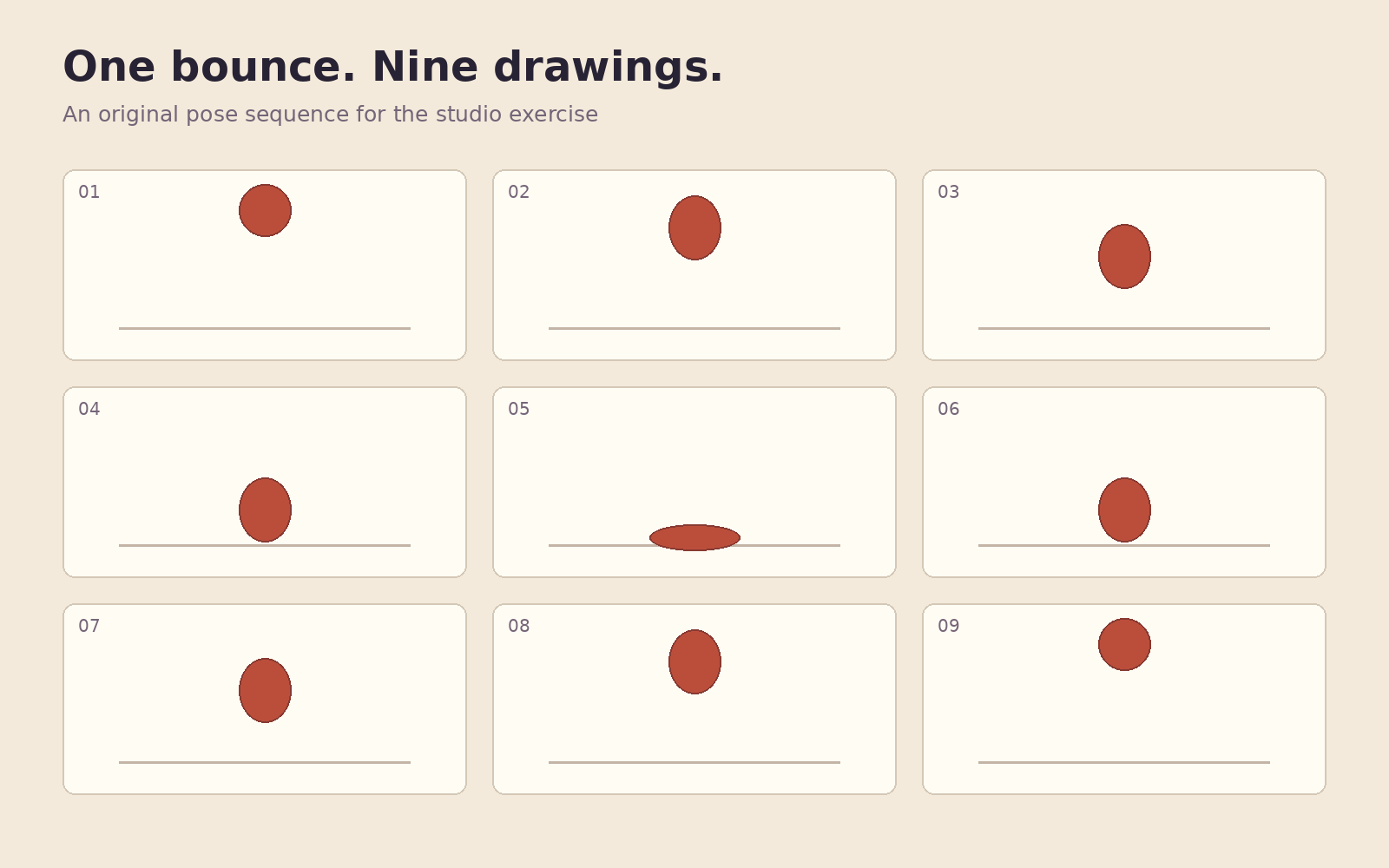
Take nine pieces of paper. Draw the same ball in slightly different positions. Flip the pages quickly and an object that never moved starts moving. This tiny miracle is the foundation of an enormous art form. It is also one of the quickest ways for an artist to discover how time changes meaning.
A flipbook is not simply an antique trick. It is a miniature laboratory for movement, expectation and visual storytelling.
WHAT OUR EYES ARE DOING Each drawing presents a still arrangement. When the positions change in a coherent sequence, the mind interprets them as continuous action. The result depends on spacing, timing, the number of drawings and the way the object changes shape. The Metropolitan Museum of Art's 2026 MetKids activity demonstrates a bouncing ball with only a small series of poses: a round ball rising, an elongated ball falling, and a flattened ball at impact. That change of shape conveys force and weight even in a simple sketch.
This is where craft enters. If every drawing is separated by exactly the same distance, motion looks regular. Put drawings close together and motion slows; spread them farther apart and it speeds up. Make an object squash at impact and the viewer can feel the collision. Nothing in the drawing literally has mass, but the timing persuades us otherwise.
THE NINE-DRAWING EXPERIMENT Use sticky notes or index cards aligned to the same corner. On the first, draw a ball near the top. Progressively lower it as it approaches the bottom. At impact, squash its shape horizontally. Then reverse the sequence so it springs upward and regains its roundness.
Now change only one variable. Add an extra drawing near the top to make the ball appear to pause. Or insert a larger gap near the bottom to make the drop accelerate. The exercise quickly shows why animation is not just illustration repeated many times. It is choreography of attention.
A SECOND LAYER: GIVE THE BALL A PERSONALITY A comic animator might make the ball hesitate before jumping. A suspenseful version might hold the last frame longer than expected. A more experimental version might replace the ball at impact with a flower, a word or a landscape texture. The viewer's brain tries to reconcile unexpected images with the movement they were already following.
The Met's audiovisual archive includes experimental animation that combines flipbooks, stop-motion and altered footage. That lineage reminds us that the medium does not belong exclusively to film studios. It belongs to anyone who experiments with sequence.
WHY THIS MATTERS FOR CONTEMPORARY ART Modern digital tools make it possible to automate transitions. That is useful, but the handmade flipbook teaches a crucial principle: a convincing transformation requires decisions about every change. Once an artist understands spacing, anticipation and impact physically, digital keyframes become easier to direct. The limitation of nine frames is productive because there is nowhere to hide an unclear idea.
A COMMUNITY CHALLENGE Create a nine-frame transformation using an object already on your desk. Trade it with another artist and ask them to change just one part of the motion. Compare how emotion and timing shifted. Musicians can improvise a sound to the sequence; filmmakers can shoot the pages and layer original audio. Artists retain ownership of their work.
Give nine frames two different lives
Build a second version alongside the first so you can compare rather than vaguely remember. Keep the ball's starting point, landing point and overall sequence the same. In version A, use fairly even spacing. In version B, place the early drawings closer together and increase the gaps approaching impact. Use the same flipping speed for both. The comparison asks how spacing changes the impression of acceleration. It is an original studio exercise based on the general principle of changing images over time, not a claim that either version reproduces a measured physical trajectory.
There is a second control worth trying. Photograph the pages with a phone held in one position, under steady light, aligning each page to the same marks. Compare the sequence at a fixed playback rate if your chosen editing tool permits it. Hand-flipping introduces variable timing and registration; that can be expressive, but it also makes a comparison harder. Keeping the presentation consistent helps isolate the drawings. Use your own pages and audio rather than lifting a soundtrack from a commercial film.
For a collaboration, give a musician only the sequence, without explaining the intended mood. Ask for two contrasting short sounds: one that follows the impact and one that anticipates it. Listen while watching the same drawings. Which version feels heavier, funnier or more anxious? These are observations for your group to discuss, not universal findings about viewers. Changing the sound can redirect the meaning even though the visible movement remains identical. This is where an illustrator and a musician can exchange decisions instead of simply supplying separate finished parts.
Finish by writing one sentence about what changed and one about what stayed fixed. Save the two versions together. A useful experiment leaves a trace that another person can inspect and repeat. The lesson carries into projection, digital animation and live visuals: decide whether you are changing position, spacing, shape, playback time or sound. When every variable changes at once, the result may be exciting, but it is harder to learn which decision gave it character.
Castle Arts Collective is building opportunities for artists, musicians and creators to learn from one another. The experiment is an invitation, not a claim about a scheduled Castle event. Artists, volunteers, mentors and venues can enquire at https://castlearts.villageropen.org/connect/.
Read the original sources
The Metropolitan Museum of Art: metkids create flipbook ↗The Metropolitan Museum of Art: metkids microscope moving images ↗The Metropolitan Museum of Art: from the vaults head ↗Sources checked October 26, 2026. Time-sensitive details should be checked again before acting.
Artists, musicians, mentors, volunteers and venues: ask about participating or collaborating through Castle Arts Collective.
Connect with Castle Arts →